You hit every deadline. Your work is error-free. You are the reliable one who stays late to fix other people’s mistakes. So, why did that promotion go to the person who spends half the day chatting by the coffee machine?
For years, we were sold a simple promise: if you do your job well, you will move up. We call this a meritocracy. But if you look around your office—or your Zoom screen—you probably already know that this promise is broken.
We are seeing a major shift in how careers work. Experts call it the “Competence Paradox.”
Here is the hard truth: being good at your technical tasks is just the entry fee. It keeps you employed, but it won’t get you promoted. With smart AI handling more of the “doing” and remote work hiding our effort, the rules have changed.
Here is what is actually holding you back and how to fix it.
1. The 10% Rule: Why Hard Work Doesn’t Speak for Itself
There is a brutal formula for career success called the P.I.E. Model. It breaks down what really determines who gets ahead. Most people assume “Performance” (doing great work) is the biggest piece of the pie.
They are wrong.
Performance is only 10%. This is your baseline. It just buys you a seat at the table.
Image is 30%. This is what people think about you. Do you look like a leader? Are you known for solving problems or complaining about them?
Exposure is 60%. This is the big one. Who knows what you do? Does the boss’s boss know your name?
If you spend 100% of your energy on that 10% slice (Performance), you are working hard on the wrong thing. You might even trap yourself. If you are too good at the daily grind, you become “too valuable to lose” in your current spot, but not visible enough to promote.
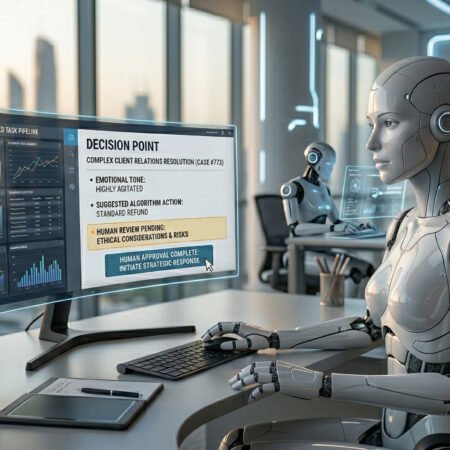
2. The AI Shift: From “Doing” to “Directing”
We used to value people for what they knew and how fast they could work. But now, we have AI agents that can code, write reports, and analyze data in seconds.
This changes your value.
If your main selling point is “I write clean code” or “I process claims quickly,” you are in trouble. A machine can do that. The new value isn’t in doing the task; it is in directing the task.
Employers are now looking for “Strategic Imagination.” They don’t need another person to grind through the inbox. They need someone who can look at a business problem and figure out how to use AI and other tools to solve it. Stop trying to out-work the robot. Start acting like the foreman who tells the robot what to build.
3. The “Invisible Employee” Problem
Remote and hybrid work are great for flexibility, but they are tough on your career. In the old days, your boss saw you sweating over a project. They saw you stay late.
Now? Out of sight is truly out of mind.
If you work from home, you miss those accidental run-ins in the hallway. You miss the chance to grab lunch with a manager from another department. This creates an “Exposure Gap.” You might be doing the best work of your life, but if no one sees it, it didn’t happen.
The Fix: You have to manufacture visibility. Don’t just finish a project; send a summary of the wins to the team. Schedule short “coffee chats” over video. It feels awkward at first, but you have to broadcast your value because no one is watching you work anymore.
4. Learn the “Hidden” Rules
Every company has two rulebooks. There is the Employee Handbook, and then there is the Hidden Curriculum.
The handbook tells you how to file expenses. The Hidden Curriculum tells you how to actually get things done. This includes:
Managing Up: This isn’t sucking up. It means understanding what keeps your boss awake at night and solving that problem. Your boss is your most important customer.
Finding Your People: You need friends at work. Not just for emotional support, but for information. The “gossip” network is often faster and more accurate than official emails.
Business Smarts: You might be a great engineer, but do you know how the company makes money? If you can’t connect your daily tasks to the company’s bank account, you will hit a glass ceiling.
5. Why “Soft Skills” Are Your Safety Net
As machines get smarter, being human becomes more valuable. Technical skills expire quickly (what you learned five years ago might be useless today). But Emotional Intelligence (EQ) never expires.
Companies are desperate for people who can:
Lead a team through stressful changes.
Negotiate with difficult clients.
Build trust when everyone is burnt out.
These are things AI cannot do. Being the person who keeps the team together is now a hard economic skill. It is your best defense against being replaced.
6. Mentors Give Advice; Sponsors Give Promotions
This is the most common mistake I see. People look for a mentor—someone to give them advice and coffee.
What you really need is a Sponsor.
A mentor talks to you. A sponsor talks about you. A sponsor is the person in the closed-door meeting who slams their hand on the table and says, “We need to give this project to Sarah.”
You can’t just ask someone to be your sponsor. You earn it. You have to prove to a leader that backing you will make them look good. Find the power players and figure out how to help them win.
The old way of working—keep your head down, do what you are told, wait your turn—is over. That path now leads to stagnation.
To win in this new environment, you need to shift from being a “reliable worker” to a “Strategic Orchestrator.”
Don’t just do the work; design how the work gets done.
Don’t just sit in the background; make sure your wins are seen.
Don’t just fix bugs; understand the business.
Stop waiting for permission to lead. Treat your role like you own the place. That is how you turn “good at your job” into a career that actually moves.